Showing posts with label Prices and Valuations. Show all posts

Friday, April 6, 2018

Tesla Bonds – Revved Up by Moody’s?

There’s one thing about equity analysts talking up Tesla and getting behind the hype: equity investors enjoy the upside if their optimistic scenarios come true. 

But bonds have only downside, and rating agencies are supposed to analyze various scenarios – the good the bad and the ugly – in coming up with bond ratings.

It doesn’t look like Moody’s did that when rating Tesla B2 and Tesla’s $1.8 billion bond issue B3 in August 2017.   Rather, they assumed as true Tesla’s optimistic production targets (or hopes) for Tesla’s Model 3 and rated Tesla based on those coming true.  To exaggerate how bizarre this approach is, had Tesla said they hope and expect to produce a million cars a day, perhaps Moody’s would have rated them Aaa!  Click, whirr

Crucially, Moody’s provided Tesla, the company and its bonds, ratings based on a picture of its future financial that exceeded its true financial position, before Tesla had met the goals that would warrant the rating.

Moody’s rating rationale reads as follows (with our emphasis added): 
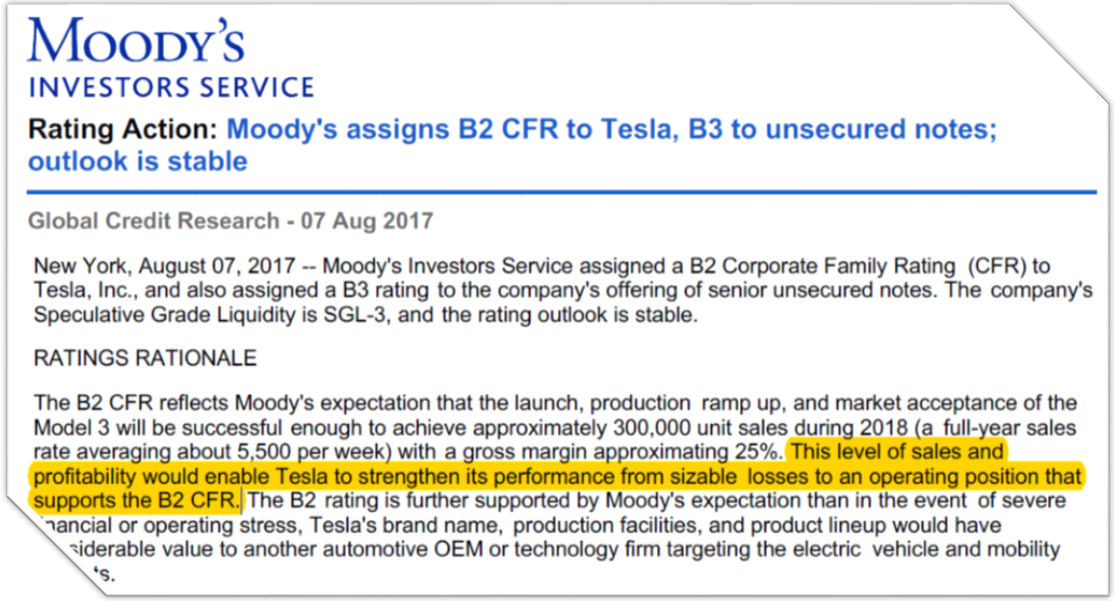
"The B2 CFR reflects Moody's expectation that the launch, production ramp up, and market acceptance of the Model 3 will be successful enough to achieve approximately 300,000 unit sales during 2018 (a full-year sales rate averaging about 5,500 per week) with a gross margin approximating 25%. This level of sales and profitability would enable Tesla to strengthen its performance from sizable losses to an operating position that supports the B2 CFR. The B2 rating is further supported by Moody's expectation than in the event of severe financial or operating stress, Tesla's brand name, production facilities, and product lineup would have considerable value to another automotive OEM or technology firm targeting the electric vehicle and mobility markets."
To use Moody's language, in short, the achievement of the goals "would enable" Tesla to achieve the rating being provided now!  Moody's has assumed a future, rosier picture of the company, and based its current rating on the achievement of this rosy future, rather than waiting for the financial position to warrant the rating provided.  

Yet in its own press release, Moody’s rating analyst Bruce Clark (Senior VP) notes that "The major challenge facing the company during the next twelve months will largely be the considerable execution risks associated with the rapid ramp up in production of a totally new vehicle." 

So, why not see if Tesla can execute before rating Tesla B2, if the B2 rating is contingent on execution at a level far beyond what Tesla has ever yet achieved?   The answer, unfortunately, is that had they looked at Tesla’s actual then-current balance sheet, they would never have rated them B2, but probably in the Caa range.   And Tesla might have gone elsewhere for its second rating (it landed up getting a B- rating from S&P) or scratched the idea of issuing this bond. In fact, Moody’s essentially acknowledges this pressure, which to us seems to be a potential conflict of interest: “Without the proceeds from the [proposed] note offering, Tesla's liquidity position would be stressed.”

Moody’s didn’t exactly mark Tesla to market did it? Moody’s marked them to an optimistic future. 

It does make one wonder where the Moody’s opinion lies if Moody's is simply going to take Tesla's management’s assumption as a given.  A good job, if you can get it, but hardly an insightful opinion. 

As it happened, towards the end of March Moody’s noticed that Tesla was still far away from achieving its optimistic goals, having suffered some production hurdles and delays not atypical for a young company producing a new vehicle.   

Moody’s downgraded the so-called “long-term” ratings in March 2018, a little more than half a year after the bonds were issued.  The long-term ratings were ultimately based on very short-term expectations.  Click, whirr. 
"[Moody’s downgrade of] Tesla's ratings reflect the significant shortfall in the production rate of the company's Model 3 electric vehicle. The company also faces liquidity pressures due to its large negative free cash flow and the pending maturities of convertible bonds ($230 million in November 2018 and $920 million in March 2019). Tesla produced only 2,425 Model 3s during the fourth quarter of 2017; it is currently targeting a weekly production rate of 2,500 by the end of March, and 5,000 per week by the end of June. This compares with the company's year-earlier production expectations of 5,000 per week by the end of 2017 and 10,000 by the end of 2018." 
Oddly, now Moody’s is no longer hinging its rating to Tesla's current expectations: “The rating could be raised if production rates of the Model 3 meet Tesla's current expectations and if the company maintains good liquidity.” 

Bondholders ought to be frustrated. They have bought into a B2 corporate family rating of a company which clearly wasn’t yet B2 at the time of the issuance. They may well have taken Caa-like risk, but only been compensated for the taking of single B risk. 

Tesla has already been downgraded, and it is arguable whether the new B3 rating is well-founded, too. The bonds have been downgraded from B3 to Caa1 and have lost roughly 3% in value on the day of the downgrade. Altogether, the bonds are down roughly 10% in price terms since issuance. 


--------------------------------------------------------------------------------------------------------------------
PF2 would like to thank Joe Pimbley for his contribution to this article.

Friday, April 7, 2017

All the Equity Research Analysts in the House say "ABB, ABB"

Alec Baldwin instructed his henchmen in Glengarry Glen Ross (1992) to "ABC."  Always Be Closing.

ABC  v  ABB
If he were a research analyst at a bank, he would have told his client-customers to "ABB."  Always Be Buying.  He would also have told them that he's, you know, objective and conflict-free, and maybe just a little bit optimistic.  So cummon, buy.  And trust me, I'm conflict-free.

This all sounds a little bit ridiculous of course, but it is the world of equity research.  It pays big bucks to say Buy.  It sours relationships just a bit to say Stay Neutral.  It really sours relationships to say Sell.  And so the banks and their analysts generally say Buy.  You say Buy to almost everything, and every now again, thinking you're a genius and praying for your Meredith-Whitney moment, you say Sell and hope that the market will prove you right very very soon ... or who knows when you may find yourself out of a job.

We're exaggerating a little, but generally banks tend to rate something like 40-50% of the universe a Buy, 40-50% Neutral, and the small remainder Sell.  Here's an example of one bank's global distribution as of sometime in 2014.


And here's one of the reasons why.

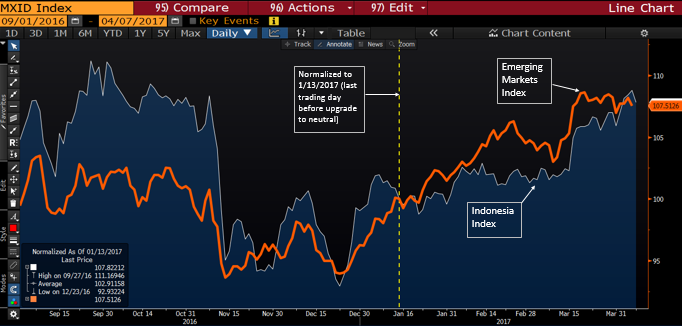
6 months ago, JPMorgan announced it was downgrading Indonesian equities to “underweight.”  That's basically a call to Sell.  Booya!  Well, what happened next was that the market showed JPMorgan analysts to have been some sort of geniuses ... but the Indonesian government wasn't quite as enthusiastic.

2 months later, the Indonesian government terminated its business partnerships with JPM, including its status as a primary dealer and a panelist for dollar-bond offerings. Argh. According to reports, Indonesian Finance Minister Sri Mulyani Indrawati would explain, when asked to comment on the termination of the JPMorgan relationship, that banks should take responsibility for economic reports that "could influence [market] fundamentals and [investment/investor] psychology".  Other reports have an Indonesian official explaining that JPMorgan's downgrade action could destabilize Indonesia’s financial system.  In short, "Show People the Optimism" ... or else No More Business for You!

2 weeks later, JPM had switched Indonesian equities back to Neutral.  This may not have been nefarious.  Sure, money speaks, but just look at how "right" the JPMorgan analysts have been!  They almost could not have hit the nail any straighter.  (Since the original downgrade, Indonesian stocks have underperformed the Emerging Market index by 4.6%; since the reversal to neutral, they have been on par just about perfectly neutral, with the difference being less than 0.1%.  Not bad for equity analysts!)


Bigger picture, however, is that we may never know to what degree business interests impacted any specific decisions.  But the bullishness of equity analysts, and the known conflicts, certain leave the analysis anything but objective and conflict-free.  (One solution is simply to disclose that the analysis is conflicted, rather than to constantly try to pretend it is objective.)

The broken-model of (bank) equity research is being revisited with the ongoing saga that is the Snap IPO, which priced in March at around a $24 billion valuation, only to move up to about $34 billion that day (roughly $25 per share).  A Bloomberg columnist found that:
  • Analysts of 13 banks that were underwriters on Snapchat’s IPO have issued recommendations on the company’s shares. Among those analysts, 69 percent issued "buy" recommendations or the equivalent, with a median price target of $27, according to an analysis of Bloomberg data. (Meanwhile, without drinking the Kool-Aid ....)
  • Of the 14 analysts whose firms didn’t work on the Snapchat IPO, only two (14 percent) said the company's stock was worth buying. The median price target among those unaffiliated analysts is $21 a share. 
Things became a little more embarrassing when it was reported that:
  • On March 27, Morgan Stanley published an equity research note on Snap, the social media company it helped take public, putting a $28 price target on the stock. 
  • Almost a day later, the bank issued a correction, changing a range of important metrics in its financial model but not the $28 price target. 
Apparently, the bank has found counter-balancing errors that allowed it to maintain the same price despite significant downward adjustments to projections.

One market commentator posed a novel theory that the market knows the price, and so the back-solving or reverse-engineering to obtain the known price doesn't make the research wrong.  But it makes us wonder ... if the goal of the research is simply to create some fancy model to justify a price that's pre-conceived, errr, what's the point?  And isn't the justification of a pre-conceived valuation misleading to the degree some of the customer-client-prospects thought is was an objective effort to analyze, you know, Snap's real and inherent value?  Of course, if it were a contest for American's Next Top Pricing Model, we would be all for producing the Sexiest Equity Pricing Solution ("SEPS").

The answer is known, of course.

The objective of equity research is to make money elsewhere in the bank, not to be smart and right, but to win (and maintain) banking business.  Equity research doesn't, alone, make money: it is given out freely to certain clients and prospects, with the expectation of revenues to be generated elsewhere, like in commissions on trades.  But if it's a free product, and its goal is to make money elsewhere, then as soon as it jeopardizes the external prospects, it becomes a burden. And the research analysts know when they're being a burden.  So they say Buy when they need to, and they say, sure, $28 dollars, the Price is Right, and boy do we have a super-model for you.  But independent and conflict-free analysis it is not.

Regulation AC tells us, essentially, that when research analysts tell clients to buy or sell a particular security, they must actually mean what they say.  But the product is sweetener.  It is quite helpful in selling the coffee.  And the coffee can't sell with a salt or pepper alternative. 

Thursday, March 23, 2017

The Art of (Illiquid) Securities Pricing

As you all know, the financial meltdown was caused by some part faulty-product (mortgages, RMBS, CDOs) and some part market-panic itself and its influence on certain other products (auction rate securities, SIVs) and market mechanics (pricing, rating).

Faulty products are not new: the world is awash with faulty products.  But we need buyers for them, and to encourage buyers we need forums (e.g. securitization) and mechanisms (e.g. ratings) that would induce buyers and give them comfort that the faulty products weren't, err, all that bad.

Well that's a long and old story.  But where we're going today is that many of the mechanics that went awry, and needn't have, have not been fixed.

Back in 2008, we had majestic moments of illiquidity, which spurred quotes like this one, from a conversation among AIG employees:
“we can’t mark any of our positions [to market price], and obviously that’s what saves us having this enormous mark to market. If we start buying the physical bonds back then any accountant is going to turn around and say, well, John, you know you traded at 90, you must be able to mark your bonds then.”
Since the crisis, the SEC has ramped up its investigations into pricing issues, and in 2013 set in motion three initiatives (the Financial Reporting and Audit Task Force; the Microcap Fraud Task Force; and the Center for Risk and Quantitative Analytics).  There has been a steady and growing stream of findings of asset valuation mismanagement.  Some hedge funds have been shut down. (A list of issues here.)

But there is much to be done, if the recent dispute between a Canadian pension fund and a US hedge fund is anything to go by.

We have written about that dispute in detail here and here, but a transcript was released as part of discovery in the matter that depicts just how tricky and error-prone our pricing systems are as soon as there is any level of illiquidity.  Before we get to the transcript, here's a brief picture of the issue at play, per the pension fund's (original) allegations.


  • Pension fund requested a full redemption of its investment in Saba’s hedge fund 
  • Prior to redemption, Saba marked down its valuation of one issuer’s corporate bonds (a relatively illiquid issuer), lowering the fund’s NAV and the amount to be returned to redeeming investors
  • Saba altered its valuation methodology to mark down the bonds issued by The McClatchy Company (“MNI”): it applied a bids-wanted-in-competition (BWIC) approach instead of relying, as usual, on its external pricing sources 

    • Saba had made sales of MNI bonds in March 2015 at prices from 58% to 60% (of par)
    • 3/31/15 mark used for redemption, based on all-or-none $50 mm BWIC: 31% 
    •  Saba later made sales of MNI bonds in April 2015 at prices from 53.75% to 55.75%
  • After the redemption was completed, Saba resumed its prior valuation methodology for MNI bonds, marking them back up

With that background, here is a concise depiction (provided here by Bloomberg columnist Matt Levine) of the hedge fund's chats with its pricing providers in 2015, demonstrating just how much the pricing process is based on art, rather than science.

  • Saba Capital's Weinstein: Z, where would you bid a few mm of the 29s with or without 5yr cds? ... 
  • Trader: most likely below where you care. 50- 2mm 
  • Weinstein: Yes, that is low I think. 
  • Trader: where would u bid? 
  • Weinstein: Who knows. See it quoted much higher. Actually you should change your 65/66 quote I guess. 
  • Trader: im happy to reflect any market you would like me to make 
  • Trader: i have no position 
  • Trader: and quote it only 
  • Trader: but thats the discount i would bid to go at risk 
  • Weinstein: Yeah, the quote seems wrong I guess. 
  • Trader: given how illiquid it is 
  • Trader: sure do u have a two sided market? 
  • Trader: or what is an appropriate quote? 
  • Weinstein: I guess if you only care at 50 on 2mm then probably 65/ for any size is wrong. 

So we have reliance, for pricing purposes, on information produced by traders who are not really willing to meet their quotes, and whose quotes may differ depending on the size of the investment, and are therefore not well-tailored to depict the hedge fund's specific investment size. The quotes are just that, quotes.  Nothing more.

The concern, then, is that the next softening in the market will also be magnified by our pre-existing market's structural deficiencies: the issues of illiquidity, and our ability to cater appropriately for them in our pricing procedures, could again magnify the uncertainties at play and exacerbate the downturn.

Right now, the price is just not right for illiquid assets, and prices are not consistently applied across firms.  We are ill-advised to think that the prices presented are in any way reliable, given the clumsy (antiquated?) nature with which those prices are derived.

More on this topic soon.
~PF2

Monday, August 15, 2016

Buy-Side Pricing Alerts

The money center banks have for years been heavily criticized for their pricing operations going awry. 

Many of these issues occur in the fixed income or over-the-counter (OTC) markets, where transparency is limited, secondary market liquidity near invisible, and pricing discrepancies sometimes easily and innocently explained away.

The banks have had their troubles and issues with consistent pricing across different divisions.  The "London whale" saga at JPMorgan was one of the big ones.  

Anybody who watched The Big Short recently will remember the palpable frustration in the air as the "shorts" waited anxiously for RMBS and CDO price depreciation, which lingered endlessly, much to their frustration, despite the obvious downward change in fundamentals.  In the book, Scion Capital’s Michael Burry is quoted as saying: 
“Whatever the banks’ net position was would determine the mark,” ... “I don’t think they were looking to the market for their marks. I think they were looking to their needs.”
Pricing Concerns ... Coming to a Fund Near You

In the Big Short, the focus on pricing was on banks' failure to lower prices quickly enough.  But pricing concerns are more typically focused in the other direction: asset price inflation. And nowadays the buy-side is taking the brunt of the investigative interest ... with the focus being drawn on their valuation of private companies.

First, let's step back.  Everybody who owns a computer (even a smartphone) can see where Apple's stock trades.  Yes there are off-exchange venues (including dark pools) but generally there is plenty of price transparency for liquid large-cap stocks.  

Importantly, all institutions would hold Apple stock at the same value on their balance sheets, whether they're long or short, expecting it to rise or fall.  Each institution's opinion doesn't matter: the market dictates.

In OTC and private company's equity valuation worlds, there isn't necessarily a ready market...so instead of marking-to-market the world more generally marks-to-model.  Each firm can hold the same security at a different price.

But the problem is, well, funds charge fees based on performance.  Higher asset prices translates into better performance.  Ergo, mark your assets higher and you'll make more money.  Voila!  Next, funds advertise their performance.  Higher marks therefore means better performance; marketing of stronger performance can translate into higher capital inflows from investors, which means more money under management, which means more fees.  Brilliant!

So that's the problem (the incentive/motivation is too compelling!).

The news pieces are coming in thick and fast.

On Friday, Reuters published a piece called: U.S. mutual funds boost own performance with unicorn mark-ups which explained that:
"The Securities and Exchange Commission (SEC) has been asking mutual fund companies how they value their stakes in companies like Uber, Pinterest Inc and Airbnb...  The regulator is worried investors could get hurt in case of a sharp tech downturn, according to two people familiar with the SEC's queries."
The WSJ had written a similar piece back in November 2015: Regulators Look Into Mutual Funds’ Procedures for Valuing Startups, noting that:
"According to a Journal analysis of data provided by fund-research firm Morningstar Inc. of startups worth at least $1 billion, there were 12 instances over the past two years in which the same company was valued differently by more than one mutual fund on the same date."  
And BloombergBusinessweek, back in March 2015, had put together perhaps the most entertaining read of all:  We Tried to Re-Create JPMorgan’s Mutual Fund Returns and Gave Up: "The bank’s impressive mutual-fund-group performance figures come with little explanation ."


-----------------------------------------------------------------------------------------------------------

We're keeping a close eye on asset pricing issues, especially in the credit space.  If you notice anything we're missing, let us know.  Click here for a compilation of pricing issues we have seen recently, including specific investigations.

Monday, May 23, 2016

Probes into Trading Executions

We've been keeping logs of valuation/pricing disputes and issues pertaining to fees charged (more regularly buy-side probes).

This new set is a little different.  Here, we're looking at investigations into whether the buyer/client/customer got a fair execution from the broker-dealer (primarily sell-side probes).

As you'll see from the following list, the regulatory heat is on...
  1. Oct. 2017: RBS to pay $44 million to settle U.S. charges it defrauded customers: "RBS will pay a $35 million fine, plus at least $9.09 million to more than 30 customers, including Pacific Investment Management Co, Soros Fund Management and affiliates of Bank of America, Barclays, Citigroup, Goldman Sachs and Morgan Stanley. Prosecutors said that from 2008 to 2013, RBS cheated customers by lying about bond prices, charging commissions it did not earn and concealing the fraud in an effort to boost profit at the customers’ expense."

  2. May 2017: SEC Charges Former Head Traders at Nomura With Fraud. "The Securities and Exchange Commission today charged a pair of former head traders who ran the commercial mortgage-backed securities (CMBS) desk at Nomura Securities International Inc. with deliberately lying to customers in order to inflate the profits of the CMBS desk and line their own pockets as a result." ... “As alleged in our complaints, Im and Chan operated under cover of an opaque CMBS secondary market to gain illegal trading profits and potentially larger bonuses by lying to firms on the other side of their trades about the prices at which they were buying and selling securities,” said Andrew M. Calamari, Director of the SEC’s New York Regional Office." 

  3. May 2017: Two Former Barclays RMBS Traders Settle Fraud Charges for False or Misleading Statements and Excessive Mark-ups; Barclays Settles Charges for Failing Reasonably to Supervise. "The SEC staff’s investigation found that Lee and Wong made false or misleading statements to Barclays RMBS customers, including false or misleading about the price at which Barclays had bought the securities; the amount of profit Barclays was making for facilitating the trades; and who owned the securities, including creating a fictional third-party to create the appearance of price negotiations." 

  4. Jan. 2017: Citadel pays SEC $22.6 million to settle charges of misleading customers. "The SEC found that between 2007 and 2010, Citadel used two algorithms to execute stock trades on customers’ behalf that gave investors a worse price for their trades, even when Citadel knew better prices existed elsewhere. The SEC penalized Citadel for failing to disclose the use of those algorithms to clients." 

  5. Sept. 2016: Ex-Morgan Stanley Trader Caught in SEC Mortgage-Bond Probe. "Bonacci, 31, misled Morgan Stanley customers in 2012 in at least five transactions about the price the bank had paid for the mortgage bonds he was selling, and how much the bank was getting paid for arranging the trades, the SEC said in an administrative order." 

  6. Sept. 2016: Westpac refunds $20m to customers over foreign transaction fees. "The Australian Securities and Investments Commission indicated the bank did not clearly disclose the transactions that attract the fees — including where transactions are made in Australian dollars but processed by overseas merchants such as Amazon." 

  7. August 2016: Former Goldman Sachs Trader Settles Fraud Charges. "An SEC investigation found that Edwin Chin generated extra revenue for Goldman by concealing the prices at which the firm had bought various RMBS, then re-selling them at higher prices to the buying customer with Goldman keeping the difference." 

  8. May 2016: Why Merrill Lynch and Stifel Were Fined by FINRA. "Merrill Lynch, Pierce, Fenner & Smith, a subsidiary of Bank of America (BAC), was ordered to pay $422,708 in fines and restitution by the Financial Industry Regulatory Authority for charging customers excessive markups and markdowns on municipal securities." 

  9. May 2016: State Street Nears Settlements to End Probes Into Alleged Overcharges. "The lawsuits accuse State Street of promising to execute foreign exchange trades for clients at market prices, but instead using inaccurate or fake rates that included hidden markups. The alleged overcharges occurred between 1998 and 2009, ..."

  10. May 2016: U.S. investigates market-making operations of Citadel, KCG.  "Federal authorities are ... looking into the possibility that the two giants of electronic trading are giving small investors a poor deal when executing stock transactions on their behalf." 

  11. May 2016: Lawson Financial, Its Top Officials Charged in Muni Case. "[FINRA] has filed a complaint against Phoenix-based Lawson Financial Corp. and the firm's president and chief executive officer, charging them with securities fraud in connection with the sale of millions of dollars of municipal revenue bonds to customers." 

  12. Apr. 2016: Three Firms Ordered by FINRA to Pay $115K for Muni, Other Violations. "Alton Securities Group, based in Alton, Ill., did not receive a fine for its conduct but was ordered to pay $75,000 in restitution, plus interest, to customers for taking excessive markups and markdowns in muni and corporate debt and for not making suitable recommendations on exchange traded funds. FINRA found in 104 muni trades occurring between February 2009 and June 2013, markups ranging from 3.01% to 4.53% that [] violated MSRB Rule G-30 on prices and commissions."

  13. Feb. 2016: Oppenheimer One of 7 Firms FINRA Fines Over Minimum Denominations. "Oppenheimer & Co., WFG Investments, and E*TRADE are three of seven firms that [FINRA] fined ... for trading municipal securities below the minimum denomination." 

  14. Jan. 2016: BNY Mellon faces lawsuit claiming FX transaction overcharges on ADRs

  15. Jan. 2016: The Hidden—and Outrageously High—Fees Investors Pay for Bonds

  16. Jan. 2016: Barclays, Credit Suisse Charged With Dark Pool Violations. “Dark pools have a significant role in today’s equity marketplace, and the firms that run these venues must ensure that they do not make misstatements to subscribers about their material operations,” said Andrew Ceresney, Director of the SEC’s Enforcement Division. “These largest-ever penalties imposed in SEC cases involving two of the largest ATSs show that firms pay a steep price when they mislead subscribers.” 

  17. July 2015: Banks are ripping off investors in overseas markets. "...these are the first in history by ADR shareholders against depositary banks, in this case Citibank and JPMorgan, according to Germinario. In the Citibank case, ..., the investors claim the bank docked fees from dividends and cash distributions by foreign companies without proper disclosure ..." 

  18. Mar. 2015: BNY Mellon Agrees to Pay $714 Million to Settle Forex Probes. "Federal and state officials alleged in lawsuits filed in 2011 that the bank misled investors about foreign-exchange deals by promising it would provide the best rates available when executing trades. Instead, the bank obtained the best rates for itself and gave less favorable terms to customers, pocketing the difference,..." 

  19. Jan. 2015: SEC Charges Direct Edge Exchanges With Failing to Properly Describe Order Types

  20. Aug. 2014: Edward Jones to Pay $20 Million for Overcharging Retail Customers in Municipal Bond Underwritings

  21. Mar. 2014: SEC Said Examining Hidden Electronic Bond Trading Prices. "The practice of dealers showing clients different prices for the same securities on electronic bond-trading platforms is drawing the scrutiny of the [SEC], which is concerned that smaller investors are being penalized." 

  22. Feb. 2014: Regulators Are Probing How Goldman, Citi and Others Divvied Up Bonds. "The Securities and Exchange Commission has sent requests for information about how banks allocate corporate-bond deals and how they traded those bonds after they were sold, the people said."
Visit our recent research piece on financial markets probes and litigation, here.

Wednesday, September 24, 2014

Securities Price Shopping

We've all heard about how Michael Lewis' book (Flash Boys) has brought a flurry of attention to the (real) movements of stocks, but his work seems also to have spurred on a host of other initiatives that were already in the works.

Importantly, the "authorities" have been paying attention to the all-important consideration of pricing (of securities).  In short, we think it's problematic that each party (fund, company, investor) gets to price its own assets. Two different banks can hold the same amount of the same investment, have the same auditor and the same regulator, and price the investment yards apart -- based on the application of different assumptions. We have a number of solutions to this problem, but have been arguing for pricing transparency (where are these prices coming from, and upon what assumptions are they based) for many years.

The SEC had previously found troubling pricing practices ("violations of law or material weaknesses in controls") in the world of private equity.  Now it has announced it found serious deficiencies in valuation processes used by hedge funds:
...regulators have discovered some funds engaging in what he called "flip-flopping," boosting valuations by changing the way they measure holdings several times a year. In some instances, the funds chose the measurement with the highest value or intentionally classified certain assets in a way that gave the fund manager more flexibility to inflate the price of the fund's holdings. (Source WSJ)
FINRA recently fined Citi upon finding that "one of Citigroup's trading desks employed a manual pricing methodology for non-convertible preferred securities that did not appropriately incorporate the National Best Bid and Offer (NBBO) for those securities." According to FINRA, "Citigroup priced more than 14,800 customer transactions inferior to the NBBO." FINRA also notes, as if it comes straight out of Flash Boys which focuses on exchange execution and the NBBO, that...
"Citigroup priced more than 7,200 customer transactions inferior to the NBBO because the firm's proprietary BondsDirect order execution system (BondsDirect) used a faulty pricing logic that only incorporated the primary listing exchange's quotation for each non-convertible preferred security."
For a list of pricing "issues" and disagreements, click here. For our other coverage on high frequency trading (HFTs), click here.

Meanwhile, we've been tracking dark pool trading flow after the recent investigations.  In an earlier blog we tabulated recent trading levels, showing the reported, dramatic, drop in trading at Barclays' dark pool.  Since then, the flow within Barclays' has stabilized and gone up just a touch in August, while overall ATS trading levels have stabilized somewhat.  This is despite any seasonality component, with general trading levels on exchanges down roughly 9.5% since June (i.e., comparing August to June).


Friday, April 4, 2014

High Frequency (Non) Trading

This week's release of Michael Lewis' new book, Flash Boys, has renewed focus on a little understood area of the market, an area that has garnered the recent attentions of market regulators, New York's Attorney General, and more recently the FBI -- but never as much attention as it garnered from Michael Lewis' interview on 60 Minutes on Sunday, with his book pending release the following day.

Without going into too many specifics, one of the central themes that Lewis discusses is the potential for high frequency traders (or HFTs) to take advantage of certain market information -- like bids and offers -- that are unknown to many other market players.

Defenders of HFTs have come out aggressively, with claims that HFTs increase market activity and liquidity, and have lowered trading costs.  The WSJ published an extensive opinion editorial by hedge fund guru Cliff Asness and his colleague Michael Mendelson of AQR, which energetically claims that much of what HFTs do is "make markets" and that they do it best because "their computers are much cheaper than expensive Wall Street traders, and competition forces them to pass most of the savings on to us investors."

Of course this sounds altogether too convincing.  Unfortunately, Asness and Mendelson provide little or no evidence (although their business as long term traders relies heavily on evidence, and they claim in the article to spend considerable energies looking into their trading costs) and they admit that they actually don't have too much conviction in the premise of their exposition:
"We think it helps us. It seems to have reduced our costs and may enable us to manage more investment dollars. We can't be 100% sure. Maybe something other than HFT is responsible for the reduction in costs we've seen since HFT has risen to prominence, like maybe even our own efforts to improve." (emphasis ours)
But this aside, no doubt all forms of HFTs bring liquidity.  They're a good thing.  Let's focus our attention elsewhere.  

Or not?

Might there be another type of HFT, that doesn't always bring liquidity for the greater good of the market ...  perhaps a type that uses obscure mechanisms to change the look and feel of the market -- to make people think there is a bid, think there is an offer, without there being one?  

This is what Flash Boys, and the interest it has invigorated in HFTs, really concerns itself with -- understanding market maneuvers like spoofing or pinging: the submission of phantom orders, immediately cancellable, that have the potential to create a false impression of market levels.

Are we creating a whole lot of (potentially fictitious) orders, but not a whole lot of activity?  Are there high-frequency non-traders?  Are we mis-marking our portfolios as a result? We continue to investigate.  But we couldn't help but bring you back to a 2013 chart from Mother Jones, which highlights the growing contrast between actual trades (in orange) and quotes/orders (in red).


Tuesday, July 3, 2012

LIBOR and Transparency

Americans obsessing over last week’s healthcare decision or zoning out ahead of July 4th may have missed the latest episode in the financial industry corruption soap opera. Last week. Barclay’s agreed to pay a $453 million fine for misreporting the rates at which it borrowed funds to the British Bankers Association, thereby distorting the value of the London InterBank Offer Rate (LIBOR). The bank’s Chairman and COO have both stepped down.

This instance of financial industry malfeasance appears to lack the compelling narrative needed to upset the general public. For those advocating on behalf of the “little guy”, this scandal may lack appeal, since most of the LIBOR manipulation appears to have been downward -thereby lowering mortgage rates paid by ordinary borrowers. Financial industry critics seem less concerned by the fact that many “little guys” who directly or indirectly invest in LIBOR-based vehicles were cheated out of some income. Journalists and bloggers have thus focused their ire on the rich and powerful individuals who have been caught cooking the books. This is unfortunate, because chopping off a few heads is not the real solution. As we will see in the coming days and weeks, misreporting of bank borrowing rates was pervasive. It is simply too tempting for most of us mortals in the financial industry to resist.

Rather than focus on the people involved or expect bank executives to morph into Mother Theresa, we should instead direct our attention to fixing the institutional framework. The problem is with how LIBOR and many other financial market prices and rates are estimated and reported. The systems we have are too easy to game and the benefits of gaming them are simply too great to resist.

In the case of LIBOR - as with bank loan prices and CDS spreads - the mechanism involves dealers reporting their bids and offers to a data aggregator, like Thomson Reuters or MarkIt. The aggregator then averages the reported quotes, often dropping the highest and lowest marks from the composite. As we’ve now seen, these dealer quotes are subject to manipulation. In less liquid markets, they may not be updated regularly since the dealer does not see new bids or offers. In either case, the composite marks reported by the aggregator do not reflect actual value.

This should concern everyone (who pays taxes to bail out banks), because it means that we don’t really know what most bank assets are worth. A better alternative would be to require all bank transactions to be reported and made publicly available. Reporting should be real time, easily accessible on the internet and as detailed as possible. Specifically, consumers of the data should be able to identify inter-dealer trades that may be executed for the purpose of manipulating mark-to-market prices.

Comprehensive transaction reporting will not be welcome by many in the financial industry. Although the major complaint may revolve compliance costs, these should be minimal, since banks already have to collect all of the transaction data for their internal systems. The real concern will be the loss of income suffered by traders, who realize significant gains from the opaqueness of many markets. Of course, that issue is much less of a concern for the rest of us.

With a few spectacular exceptions, prices of equities and other exchange traded products have proven trustworthy because of their relative transparency. By making markets for bank funding, asset backed securities, derivatives and exotic fixed income instruments more transparent, we can restore trust in quoted prices, enhance liquidity and increase the stability of our financial system.

Rather than simply scapegoating those who were caught, let’s use the LIBOR scandal as an opportunity to provide more transparent and reliable pricing not only to the market for short term bank financing, but to all markets touched by our “too big to fail” financial institutions.

Wednesday, April 4, 2012

Multiple Rating Scales: When A Isn’t A

Philosophers from Aristotle to Ayn Rand have contended that “A is A.” Apparently none of these thinkers worked at a credit rating agency - in which “A” in one department may actually mean AA or even BBB in another. While the uninitiated might naively assume that various types of bonds carrying the same rating have the same level of credit risk, history shows otherwise.

During the credit crisis, AAA RMBS and ABS CDO tranches experienced far higher default rates than similarly rated corporate and government securities. Less well known is the fact that municipal bonds have for decades experienced substantially lower default rates than identically rated corporate securities – and that the rating agencies never assumed that a single A-rated issuer ought to carry the same credit risk in both sectors. This discrepancy was noted in Fitch’s 1999 municipal bond study and confirmed by Moody’s executive Laura Levenstein in 2008 Congressional testimony on the topic. Later in 2008, the Connecticut attorney general sued the three major rating agencies for under-rating municipal bond issues relative to other asset categories. (The suit was recently settled for $900,000 in credits for future rating services, but without any admission of responsibility). Last year, three economists – Cornaggia, Cornaggia and Hund – reported that government credit ratings were harsher than those assigned to corporates, which, in turn, were more severe than those assigned to structured finance issues.

One might ask why it is important for ratings in different credit classes to carry the same expectation in terms of either default probability or expected loss? Perhaps we should accept the argument that ratings are intended to simply provide a relative measure of risk among bonds within a given asset class.

There are at least two problems with this approach. First, it is unnecessarily confusing to the majority of the population that is unaware of technical distinctions in the ratings world. Second, it creates counterproductive arbitrage opportunities.

If an insurer is rated AAA on a more lenient scale than insurable entities in another asset class, the insurer can profitably "sell" its AAA rating to those entities without creating any real value in the process.

Municipal bond insurance is a great example. Monoline bond insurers like AAA-rated Ambac, FGIC and MBIA insured bonds issued by states, cities, counties and other municipal issuers for three decades prior to the 2008 financial crisis. In some cases, the entities paying for insurance were of a stronger credit quality than the insurers. As it happened, the insurers often failed while the issuers survived, leaving one to wonder why the insurance was necessary.

During this period, general obligation bonds had very low overall default rates. According to Kroll Bond Rating Agency’s Municipal Default Study, estimated annual municipal bond default rates by issuer count have been consistently below 0.4% since 1941. Similar findings for the period 1970-2010 are reported in The Bloomberg Visual Guide to Municipal Bonds by Robert Doty. This 0.4% annual rate applies to all municipal debt issues, including unrated issues and revenue bonds. The annual default rate for rated, general obligation bonds is less than 0.1%.

Given this long period of excellent performance, one might reasonably expect that most states and other large municipal issuers with diversified revenue bases to be rated AAA. No state has defaulted on its general obligation issues since 1933, and most have relatively low debt burdens when compared to their tax base. Despite these facts, the modal rating for states is typically AA/Aa with several in the A range. (This remains the case despite certain rating agencies’ claims that they have recently scaled up their municipal bond ratings to place them on a par with corporate ratings).

The depressed ratings created an opportunity for municipal bond insurers to sell policies to states that did not really need them. For example, the State of California paid $102 million for municipal bond insurance between 2003 and 2007. Negative publicity notwithstanding, the facts are that single A rated California has a Debt to Gross State Product ratio of 5% (in contrast to a 70% Debt/GDP ratio for the federal government) and that interest costs represent less than 5% of the state’s overall expenditures. While pension costs are a concern, they are unlikely to consume more than 12.5% of the state’s budget over the long term – not nearly enough to crowd out debt service.

California provides but one example. The Connecticut lawsuit mentioned above also cited unnecessary bond insurance payments on the part of cities, towns, school districts, and sewer and water districts.

Meanwhile, AAA-rated municipal bond insurers carried substantial risks, evident to many not working at rating agencies. For example, Bill Ackman found in 2002 that MBIA was 139 times leveraged. As reported in Christine Richard’s book Confidence Game, Ackman repeatedly shared his research with rating agencies – to no avail.

This imbalance between the ratings of risky bond insurers and those of relatively safe municipal issuers essentially created the monoline insurance business – a business that largely disappeared with the mass bankruptcy and downgrading of insurers during the 2008 crisis.

Inconsistent ratings across asset classes thus do have real world costs. In the US, taxpayers across the country paid billions of dollars over three decades for unneeded bond insurance. Individual municipal bond investors, often directed by their advisors to focus on AAA securities only, missed opportunities to invest in tens of thousands of bonds that should credibly have carried AAA ratings, but were depressed by the raters’ inopportune choice of scale.

We believe that one reason for the persistent imbalance between municipal, corporate and structured ratings is the dearth of analytics directed at government securities. Rating agencies and analytic firms offer models (and attendant data sets) that estimate default probabilities and expected losses for corporate and structured bonds. Such tools are relatively rare for government bonds. Consequently, the market lacks independent, quantitatively-based analytics that compute credit risks for these instruments. This lack of alternative, rigorously researched opinions allows the incorrect rating of US municipal bonds to continue, without the alleviation of a positive feedback loop.

Next month, PF2 will do its part to address this gap in the marketplace with the release of a free, open source Public Sector Credit Framework, designed to enable users to estimate government default probabilities through the use of a multi-period budget simulation. The framework allows a wide range of parameterizations, so you may find it useful even if you disagree with the characterization of municipal bond risk offered above. If you wish to participate in beta testing or learn more about this technology please contact us at info@pf2se.com, or call +1 212-797-0215.

--------------------------------------------
Contributed by PF2 consultant Marc Joffe. Marc previously researched and co-authored Kroll Bond Rating Agency’s Municipal Default Study.

Thursday, December 1, 2011

The Art of Pricing (and the Heart of the War)

The fight for transparency in the financial markets is gaining traction.

Even maverick Judge Rakoff, in his SEC v. Citi settlement ruling, got in on the act with commentary that resonates: “In any case like this that touches on the transparency of financial markets whose gyrations have so depressed our economy and debilitated our lives, there is an overriding public interest in knowing the truth.”

The recent media coverage on the transparency issue is particularly acute as it pertains to asset pricing transparency, which is becoming ever more important as the market seeks alternatives to ratings-based capital allocations, per the requirements of Dodd-Frank.

The problem is that while each asset has only one rating (from each rating agency), there’s no consistency of pricing from one bank to the next. We fear that absent a centralized or standardized solution, any mark-to-market pricing will continue to cause headaches in markets where assets aren’t actually traded (there’s no ready or visible price).

Floyd Norris explains in a recent piece that “[under] the [accounting] rules, banks have a choice of three ways to report the value of identical securities. Even if two banks are using the same valuation method for the same security, they can come up with different values, and it is very difficult for an investor to get any feel at all for just how optimistic, or pessimistic, a bank’s estimates might be.”

He also brings in a quote from former FASB member Ed Trott, explaining that “’we are moving back to the past’ by increasing the ability of banks to massage their numbers as they wish.”

This revelation (unfortunately) jibes well with Gretchen Morgenson’s commentary in her piece entitled Slipping Backward on Transparency for Swaps. Gretchen explains that “[right] now, many swaps are traded one-on-one, over the telephone. The price is usually whatever the dealer says it is.” (Recall in Michael Lewis’ The Big Short, when Scion Capital’s Michael Burry warns that “[whatever] the banks’ net position was would determine the mark,” and that “I don’t think they were looking to the market for their marks. I think they were looking to their needs.”)

And the problem isn’t limited to the comparability of asset valuations at the Big Banks. The Big Auditors are also coming a cropper in their audits of banks. Norris explains in a separate piece that analyzes the PCAOB’s oversight reports of KPMG and PricewaterhouseCoopers: “[one] virtually identical criticism of the two firms could be a sign of the way all the firms have been auditing how banks value hard-to-measure financial assets.”


“In three of these audits,” the board wrote in its report on KPMG’s audits done in 2010, “for certain financial instruments the firm obtained multiple prices and used the price closest to the issuer’s recorded price in testing its fair value measurements, without evaluating the significance of differences between the other prices obtained and the issuer’s prices.”

With the banks being able to extract greater margins from opaque markets, the war over asset price transparency is currently being won by the might-makes-right team.

But a more simple solution that levels the playing field for investors big and small, and reduces the burden (and cost) of each auditor having constantly to reinvent the wheel, is to create a central platform for pricing.

Confidence will increase in the adequacy, verifiability, and consistency of financial statements. Regulators would have a field day and investors would be better able to spot when they’re being fooled. Of course the Banks wouldn't be too happy.

Here’s an analysis we put together of the material benefits afforded by a centralized (and perhaps standardized) pricing solution.

Update Dec. 2: According to a Bloomberg article by Jesse Hamilton that came out this morning (SEC’s Data Crunchers Find Red Flags Leading to Hedge-Fund Cases), the SEC through a prorietary tool, has been increasingly been taking action against hedge funds for misconduct including "fraudulent valuations and misrepresenting fund investors."

Hamilton brings in a relevant quote from Bruce Karpati, co-chief of the SEC's asset management enforcement unit:
“Hedge-fund managers depend on valuation and performance for both their compensation and marketing,” ... “These managers have either manipulated performance or engaged in other falsehoods in order to line their own pockets at the expense of investors.”

----------------------------
For a updated list of disputes around asset prices provided, click here.

Tuesday, August 23, 2011

Complexity is a Cash Cow (but not for you)

“Fortuna's wheel had turned on humanity, crushing its collarbone, smashing its skull, twisting its torso, puncturing its pelvis, sorrowing its soul. Having once been so high, humanity fell so low. What had once been dedicated to the soul was now dedicated to the sale.” – from John Kennedy Toole’s A Confederacy of Dunces

Frank Partnoy, in his recent Financial Times commentary, makes the bold point that while “[most] for-profit companies are run for the benefit of shareholders … banks have been run more for the benefit of employees.”

Partnoy doesn’t delve too deeply into the basis for his claim, but he may well be alluding to the fact that traders were being financially rewarded for executing trades that brought short-term profits at the expense of long-term pain.

We have all heard about the Abacus case, where the bank was accused of siding with one client at the expense of others. (Goldman settled with the SEC for $550mm). In other cases it is argued that banks actually positioned themselves in direct opposition to their clients. Needless to say it doesn’t augur well from a long-term, shareholder value perspective for a bank to be adverse to its clients. Either the bank will suffer or its client will suffer.

From a corporate governance perspective one might argue that senior management failed to the extent its traders were not being compensated based on the long-term quality of their decisions, but rather on their short-term profits. In such a scenario, the traders would not have been incentivized, or forced, to consider the long-term benefits of strong client relationships. They would simply want to execute high margin, million dollar trades.

And hence the layering on of complexity, and the disappearance of transparency.

Complexity

Complex, opaque, private trades afford broker-dealing banks numerous short-term money-making opportunities.

First up, the lack of asset transparency (inability to see through to the asset’s support) and trading transparency (inability, due to the private nature of certain markets, to follow the money or the trading levels) makes it easier for banks to get away with manufacturing prices to their advantage, or taking advantage of comparatively unsophisticated (trusting) clients.

Jim Grant (founder of Grant’s Interest Rate Observer) posited in a recent Bloomberg interview that the world we live in “is a world of fake prices and of manipulated prices.” For liquid, traded securities like municipal bonds or US Treasuries, it is understandably quite difficult to massage the numbers; but for lesser-traded, or illiquid, assets price discovery can be cumbersome if not impossible, making price manipulation all the more feasible.

In Michael Lewis’ The Big Short, Scion Capital’s Michael Burry warns that “[whatever] the banks’ net position was would determine the mark,” and that “I don’t think they were looking to the market for their marks. I think they were looking to their needs.”

The lack of transparency, too, is entirely convenient to banks in the know: it creates numerous opportunities to profit at the expense of those with less information. We call this imbalance an "informational asymmetry." It may be very difficult to sell Apple stock at an above-market price to even the least sophisticated of investors: they can readily tell that the security ought to be valued lower. But when the security is complex and privately traded, and when the comparatively unsophisticated investors do not have the market know-how or savvy to model the deals, it can be much easier for a bank to "pull one over" on them. The Fed ponders the severity of this very advantage in its aptly titled report "Could Asymmetric Information Alone Have Caused the Collapse of Private-Label Securitization?"

Complexity also undermines the potential for investigative journalism (they cannot get access to the data or make a complex deal sound too interesting) and, more importantly, the ability for regulators to oversee the markets they regulate. The IMF in 2006 warned that “[while] structured credit products provide a wealth of market information, there remains a paucity of data available for public authorities to more quantitatively assess the degree of risk reduction among banks and to monitor where credit risk has gone.”

Investors would do well to acknowledge the incongruent incentives banks may have to add their complexity to their products. But as buyers, complex deals can be difficult – and expensive – to analyze, and cumbersome if not impossible to trade (out of) during times of heightened volatility.

Investors can push back when offered complex deals that don’t meet their interests – and they can strive to ensure that their rights to high quality information and transparent disclosures are upheld.

Complexity allows for high margin trades that elicit high profits, but sometimes on terms that are not commercially reasonable. And in times of high volatility, they tend to be accompanied by high bid-offer spreads. As always, it’s buyer beware.

Tuesday, May 10, 2011

Pricing Transparency

Professor Allan Meltzer argues, in yesterday’s WSJ article BlackRock's 'Geeky Guys' Business, that BlackRock Solutions’s pricing process “should all be open” and that “[they] may be doing things honestly and above board, but we won’t see that unless we see how they got the numbers.”

While legislators and supervisors scurry to plug the holes created by the absence of both balance sheet and asset transparency, the final piece of the puzzle – pricing transparency – remains largely unattended to.

It is this final element, the lack of pricing transparency, that concerns Prof. Meltzer. Right now, hedge funds, banks and insurance companies can all carry the same asset at a different price. In illiquid markets, the price differential between two price providers can be extraordinary, creating an opportunity for lesser-regulated financial institutions to profit handsomely from the regulatory arbitrage available, at the expense of their more heavily-regulated counterparts.

As with “ratings shopping” where market participants seek the highest ratings on their securities, investors are financially incentivized to seek out the highest value they can find for each security. Funds’ performance (and often their managers' bonuses) is directly determined from the valuations of their assets. Stronger performance, whether real or artificial, can even help a fund or company raise new capital.

Thus, there remains significant potential for derivatives mispricing. One could even argue that the potential for mispricing is heightened when the price provider offers additional advisory services to the client. Given the substantial fees and margins that may be earned on the advisory side, a conflicted price provider may be more open to accommodating a client’s price haggling to win or maintain it as a client.

Prof. Meltzer’s goal for pricing transparency would hone in on, perhaps eliminate, numerous possible sources for deliberate mispricing (see list of contested pricings here). While we fear it may be prove an insurmountable hurdle to require pricing providers to share transparency as to their methods, we feel strongly that an opportunity exists now for market regulators to ensure the consistency of prices used. (See Central Pricing Solution here.)

Absent complete pricing transparency, the usage of consistent prices would serve to increase investor confidence as to the adequacy of financial institutions’ balance sheets. A requirement for all constituents supervised by the same regulatory body to apply the same price can discourage price haggling, or price shopping.

Wednesday, April 13, 2011

Split Ratings

Given the high correlation between security prices and their ratings, we wanted to follow up on some of our prior pieces that contemplated the wide discrepancies between ratings opinions provided on certain securities (see for example here and here). Split ratings, of course, present trading opportunities.

Our analysis considered securities that were acted upon by a single rating agency between June and August of 2009. We then had a look at the average ratings split as of March 28 this year: one and a half years later. The outcome was quite astonishing.

While at inception the rating agencies seem typically to achieve the same rating, down the line they tend to substantially disagree with one another. (We have broken the differential down depending on how many rating agencies rated each security. If all three of Moody's, Fitch and S&P rated the security, we'll show both a max split and a minimum split. If only two raters rated the security as of March 28, 2011, the max split equals the min split.) The average max differential: 4.23 rating subcategories (or "notches"). The median differential - 3 notches. One rating subcategory would be the difference between a AAA and a AA+.

This table shows examples of the 748 structured finance securities considered in our database at each ratings split level, including one of the 20 securities on which there was a ratings differential of between 14 and 18 ratings subcategories.


For the purposes of this analysis, securities were only considered to the extent they had ratings outstanding from at least two of the Big Three credit rating agencies as of March 28, 2011.

Thursday, April 7, 2011

Contested Pricings List

The capacity for price manipulation or price inflation presents a major challenge for the market to overcome, especially in the illiquid markets where live trading data are seldom made available to the general public. Like "ratings shopping," investors may be incentivized towards seeking the highest price, or most accommodating price provider, for their securities.

We will continue to maintain this growing database of situations in which parties disagree as to the prices used, or pricing practices employed.

  1. Apr. 2021: Behind the Mysterious Demise of a $1.7 Billion Mutual Fund: "The Infinity Q Diversified Alpha Fund disclosed in filings with the Securities and Exchange Commission valuations of investments that in at least three instances were incorrect or inconsistent with market conditions, said traders and academics."

  2. Jan. 2021: Exxon Draws SEC Probe Over Permian Basin Asset Valuation: "The Securities and Exchange Commission launched an investigation of Exxon Mobil Corp. after an employee filed a whistleblower complaint last fall alleging that the energy giant overvalued one of its most important oil and gas properties, according to people familiar with the matter."

  3. Apr. 2019: Direct Lending Investments, LLC: "According to the SEC’s complaint, Direct Lending, through its owner and CEO Brendan Ross, engaged in a multi-year effort to manipulate the performance data for one of Direct Lending’s significant investments in loans made by an online small business lender. This materially inflated Direct Lending’s assets under management and its reported returns, and resulted in approximately $11 million in over-charges of management and performance fees to its private funds."

  4. Jun. 2018: Hedge Fund Adviser to Pay $5 Million for Compliance Failures Related to Valuation of Fund Assets: "An SEC investigation found that Colorado-based investment adviser Deer Park Road Management Company LP, in connection with its flagship STS Partners’ fund which has been ranked as one of the most consistent performing hedge funds in the country, failed to have policies and procedures to address the risk that its traders were undervaluing securities and selling for a profit when needed. The firm also failed to guard against its traders’ providing inaccurate information to a pricing vendor and then using the prices it got back to value bonds. CIO Scott Burg oversaw the valuation of certain assets in the flagship fund and approved valuations that the traders flagged as “undervalued” with notations to “mark up gradually.” Also overseeing valuation was a committee comprised of the principal’s relatives and others without relevant expertise."

  5. Mar. 2018: A private equity star's picks shine ... until cash-out time: "Since Catalyst launched its second fund in 2006, however, the firm’s record of double-digit annual returns has been based largely on its own assessments of improvements to its stable of distressed companies. When put to the test, at least four of Catalyst’s major assets have been unable to find buyers at the firm’s valuations, based on a Reuters review of Catalyst’s portfolio, multiple communications from Catalyst to its clients and regulatory filings, as well as interviews with people familiar with Catalyst’s operations, academics and financial analysts."

  6. Mar. 2018: Glaucus targets Blue Sky Alternative Investments as next Australian short: "The hedge fund argues Blue Sky stock is over-valued, and worth no more than $2.66 a share. Further, Blue Sky is alleged to have overstated the amount of assets under management (AUM) that are capable of earning fees, which Glaucus asserts is "at most $1.5 billion" and not the $3.9 billion the company reported at its February results. Central to its thesis is that Blue Sky has succeeded by "aggressively" marking up the value of unlisted assets so it can charge higher fees and flatter its returns, lifting its share price."

  7. Feb. 2018: Credit Suisse hit by U.S. lawsuit over writedowns, says case "without merit": "[A] class action lawsuit in New York accuses the bank, Thiam and Mathers of giving false and misleading information about risky investments that led to a drop in Credit Suisse’s share price, costing investors millions, the newspaper reported."

  8. Feb. 2018: Nomura Suspends Two Junk-Bond Traders in London: "In the decade since the financial crisis, banks around the world have paid more attention to how they value harder-to-trade debt securities, such as those backed by mortgages, or loans financing leveraged takeovers. Regulators and banks have cracked down on suspected instances of so-called mismarking, in which traders misrepresent the true value of securities."

  9. Feb. 2018: Deer Park Road Draws SEC Probe Over Bond Valuations: "The Securities and Exchange Commission is questioning why the fund priced certain debt positions below market norms, said one of the people, who asked not to be identified because the probe isn’t public. The inquiry focuses on the pricing of hard-to-value residential mortgage-backed securities, some of which can go months without trading."

  10. Dec. 2017: SEC Probes If Banks Helped Hedge Funds Inflate Returns: "The U.S. Securities and Exchange Commission is now investigating whether some banks crossed the line to win business by offering hedge funds bogus price quotes on hard-to-value bonds, said two people familiar with the matter. The SEC’s concern: As a reward for helping hedge funds make money -- by submitting quotes at requested levels -- banks got trades steered their way."

  11. Dec. 2017: Intrepid writes down mining properties: "ASIC notes the decision by Intrepid Mines Limited (Intrepid) to make a $16.1 million impairment charge against its Zambian mining properties in its financial report for the half-year ended 30 June 2017. ... Intrepid announced a subsequent sale of its Zambian assets for $4.75 million plus $1 million deferred contingent payments on 12 December 2017, resulting in a further loss."

  12. Oct. 2017: Rio Tinto, Former Top Executives Charged With Fraud: "The Securities and Exchange Commission today charged mining company Rio Tinto and two former top executives with fraud for inflating the value of coal assets acquired for $3.7 billion and sold a few years later for $50 million."

  13. Oct. 2017: Ex-Third Point Partner’s Bond Trades Focus of SEC Probe: "U.S. regulators are investigating whether a top trader who left Dan Loeb’s Third Point hedge fund earlier this year contributed to the mispricing of hard-to-value mortgage bonds, two people familiar with the matter said. The Securities and Exchange Commission is probing whether former Third Point partner Keri Findley caused the thinly traded bonds to be undervalued, said the people who asked not to be named because the probe isn’t public. Findley, 35, left the $18 billion firm in February, telling people who had direct communications with her that she was retiring and moving to California."

  14. Oct. 2017: RBS to pay $44 million to settle U.S. charges it defrauded customers: "RBS will pay a $35 million fine, plus at least $9.09 million to more than 30 customers, including Pacific Investment Management Co, Soros Fund Management and affiliates of Bank of America, Barclays, Citigroup, Goldman Sachs and Morgan Stanley. Prosecutors said that from 2008 to 2013, RBS cheated customers by lying about bond prices, charging commissions it did not earn and concealing the fraud in an effort to boost profit at the customers’ expense."

  15. Aug. 2017: SEC Order: In the Matter of KPMG LLP AND JOHN RIORDAN, CPA: "This case involves improper professional conduct and securities law violations by KPMG and Riordan relating to a review and audit of the financial statements of Miller Energy Resources, Inc. (“Miller Energy”). During its fiscal 2010, Miller Energy acquired certain oil and gas interests located in Alaska (the “Alaska Assets”) for an amount the company estimated at $4.5 million and then subsequently reported those assets at an inflated value of $480 million in its fiscal 2010 financial statements. This asset valuation violated generally accepted accounting principles (“GAAP”) and overstated the fair value of the assets by hundreds of millions of dollars."

  16. Aug. 2017: One of Canada’s largest private-equity firms accused of fraud: "Canadian securities regulators received four independent whistleblower complaints against a multibillion-dollar investment firm Catalyst Capital Group Inc., The Wall Street Journal reported ... The case was brought to the country’s leading securities regulator — Ontario Securities Commission. According to the complaints it was artificially inflating the value of some of its assets and deceiving borrowers about the terms of loans it made."

  17. May 2017: Hedge Funds Are Facing a U.S. Criminal Probe Over Bond Valuations: "The witness, a former broker named Frank DiNucci Jr., said under oath that he provided bogus quotes to a trader at a mortgage bond fund, Premium Point Investments LP. DiNucci agreed to plead guilty last month in Manhattan federal court to conspiracy and fraud and says he has been cooperating with a criminal probe by New York prosecutors into Premium Point." ...“I would extend marks to make them seem like they were my own,” DiNucci told the federal jury in Hartford. The goal was to “increase the number of trades we would do with this particular client,” he said.

  18. Apr. 2017: Lehman Suit Seeks Return of $2 Billion in 'Phantom' Citi Fees: "The trial opens a rare window into the frenzied weekend before Lehman’s bankruptcy filing on Sept. 15, 2008. Banks were supposed to use a Sunday trading session to mitigate damage to the financial system by reducing their exposure to the bank. Lehman, which first sued over the $2 billion in 2012, claims that Citigroup efficiently hedged its risks, but went on to inflate its claim by marking its books to its benefit." ... "Marc Pagano, who ran Citigroup’s emerging-markets business at the time and was involved in closing out some of his group’s trades, was asked in a phone conversation -- a recording of which was played in court Wednesday -- whether traders were supposed to mark their books under a different methodology than usual. “Yeah, one night. One night only,” Pagano said in the call. “We only deviated one night.” 

  19. Feb. 2017: Mortgage investor Premium Point discloses SEC probe: Premium Point Investments LP is under investigation by the U.S. Securities and Exchange Commission over the valuation of structured products and other assets held by its funds, according to a letter sent to clients of the New York-based investment firm.

  20. Jan. 2017: SEC Reviews Bond Trades by Hedge Funds, Devaney’s Firm: At issue, the people said, are trades between hedge funds -- including Candlewood Investment Group -- and United Capital Markets, a brokerage owned by John Devaney. Investigators at the U.S. Securities and Exchange Commission are trying to determine if the prices in small transactions were reasonable or were inflated to allow the parties to record gains on bigger holdings of the securities, according to the people. Devaney said there has been no suggestion by regulators that his firm engaged in misconduct.

  21. Dec. 2016: ECB Found Deutsche Bank Risk Management Weakness: "A European Central Bank inspection of Deutsche Bank AG’s risk controls found deficiencies in derivatives and complicated financial bets that raise questions about pricing processes at the German lender, Il Sole 24 Ore reported."

  22. Dec. 2016: Wall Street Cop Asks Money Managers To Reveal Silicon Valley Valuations: "Federal securities regulators are intensifying efforts to determine how large U.S. money managers value some of the best-known private technology companies, such as Uber Technologies Inc. and Airbnb Inc. In recent weeks, the Securities and Exchange Commission sent letters to or spoke with several mutual fund firms including T. Rowe Price Group Inc. and Fidelity Investments, according to people familiar with the matter."

  23. Oct. 2016: Deutsche Bank Said to Review Valuations of Inflation Swaps: "The bank is looking at valuations on a type of derivative known as zero-coupon inflation swaps, said the people, who asked not to be identified because the matter is confidential. After finding valuations that diverged from internal models, it began questioning traders, the people said."

  24. Aug. 2016: Legal Fight Escalates Over Tech Startup’s Financials: "Mr. Biederman holds 64,166 Domo shares that would be worth $540,919 at the $8.43-per-share price where Domo sold stock to investors last year. But some mutual-fund investors have since marked down their Domo shares, according to The Wall Street Journal’s Startup Stock Tracker. Morgan Stanley said Domo shares were worth $5.04 a share as of May."

  25. Aug. 2016: Former Deutsche Bank Trader Fined $50,000 by SEC Over Valuations: "A former Deutsche Bank AG trader agreed to settle a U.S. regulator’s allegations that he mis-marked loans tied to commercial-mortgage-backed securities to boost his profits" ... "The SEC has made policing bond valuations a priority. The agency and the Justice Department have brought civil and criminal cases against traders for lying about bond prices to customers. The SEC is using algorithms to comb through bond trading and has found billions of dollars worth of problematic transactions."

  26. Aug. 2016: U.S. mutual funds boost own performance with unicorn mark-ups: "The Securities and Exchange Commission (SEC) has been asking mutual fund companies how they value their stakes in companies like Uber, Pinterest Inc and Airbnb. The regulator is worried investors could get hurt in case of a sharp tech downturn, according to two people familiar with the SEC's queries."

  27. July 2016: Fraud Probe Ricochets Through Platinum Partners: "Among questions investigators seek to answer is whether Platinum misstated values of some holdings, the people familiar with the probe said. Platinum spokesman ... defended the firm’s auditing and valuation methods and said it stands behind its performance record."

  28. July 2016: LendingClub Fund Has Its Version of June Swoon: "LendingClub also said in the filing that LC Advisors hadn't followed standard accounting rules when it was determining the value of the loans in its portfolio as well as their monthly returns. Investors affected by the adjustments would be reimbursed around $800,000,...."

  29. June 2016: CMBS Servicers Sued in Fair-Value Option Case for 'Flawed' Appraisal: An investor in a 2007 CMBS transaction has sued the deal's master and special servicers, arguing that they breached their obligations under the deal's pooling and servicing agreement when they allowed a collateral $84.8 million loan to be sold using a fair-value purchase option.  

  30. June 2016: ASIC calls on directors to apply realism and clarity to financial reports. "ASIC continues to find impairment calculations based on unrealistic cash flows and assumptions, as well as material mismatches between the cash flows used and the assets being tested for impairment.... Fair values attributed to financial assets should also be based on appropriate models, assumptions and inputs."

  31. May 2016: Wall Street Cops to Hedge Funds: Treat Investors Better: "Regulators are looking into whether a firm employed by RD Legal as its independent valuation agent, Pluris Valuation Advisors LLC, ever contested any of the firm’s preferred valuations, people familiar said."

  32. May 2016: Banks Sued by Investor Over Agency-Bond Rigging Claims. "The lawsuit... accuses traders of colluding with one another to fix prices at which they bought and sold SSA bonds in the secondary market. It adds the threat of possible triple damages available under U.S. antitrust law for investors harmed by any illegal price-fixing."

  33. Mar. 2016: A $7 billion hedge fund says it's being investigated by the SEC and the US Department of Justice: "They have requested information from several years ago regarding the valuation of certain securities in the firm's credit fund which was closed in 2013,..."

  34. Feb. 2016: Loan Valuations Draw Scrutiny: Some firms are marking down securities faster than others

  35. Nov. 2015: Regulators Look Into Mutual Funds’ Procedures for Valuing Startups
     
  36. Sept. 2015: Canadian Pension Fund Says It Was Cheated By Boaz Weinstein's Saba Capital

  37. May 2015: SEC Charges Deutsche Bank With Misstating Financial Reports During Financial Crisis: “An SEC investigation found that Deutsche Bank overvalued a portfolio of derivatives consisting of “Leveraged Super Senior” (LSS) trades through which the bank purchased protection against credit default losses."

  38. May 2015: Alleged Fund Fraud Exposes Cracks in Securities Pricing: “The trustees have determined that the valuation of the fund’s assets may not be reliable,” the board wrote in a letter to shareholders after [manager] Thibeault’s arrest that month.

  39. May 2015: We Tried to Re-Create JPMorgan’s Mutual Fund Returns and Gave Up: The bank’s impressive mutual-fund-group performance figures come with little explanation

  40. Mar. 2015: SEC Announces Fraud Charges Against Investment Adviser Accused of Concealing Poor Performance of Fund Assets From Investors: The SEC’s Enforcement Division alleges that Lynn Tilton and her Patriarch Partners firms have breached their fiduciary duties and defrauded clients by failing to value assets using the methodology described to investors in offering documents for the CLO funds, which have portfolios comprised of loans to distressed companies.

  41. Sept. 2014: SEC Finds Deficiencies at Hedge Funds: Shortcomings Include Valuation 'Flip Flopping'

  42. Sept. 2014: Pimco ETF Draws Probe by SEC: Regulators Are Probing Whether Returns Were Artificially Inflated

  43. Aug. 2014: FINRA Fines Citigroup Global Markets: "Citigroup priced more than 7,200 customer transactions inferior to the NBBO because the firm's proprietary BondsDirect order execution system (BondsDirect) used a faulty pricing logic"

  44. June 2014: Ex-Millennium Fund Manager Gets Four Years in Prison: "Former Millennium Global Investments portfolio manager Michael Balboa was sentenced to four years in prison for defrauding investors by inflating the value of Nigerian sovereign debt by $80 million." ... "Balboa, a London-based investment manager, was convicted of providing fake valuations to inflate month-end market prices on Nigerian warrants. The scheme generated millions of dollars in management and performance fees for which he earned as much as $6.5 million, prosecutors said."

  45. Feb. 2014: SEC Looking at How Alternative Funds Value Investments

  46. Feb. 2014: Danske Bank Faces Broader Probe of Bond Price Fixing in 2009: "The trades, conducted in February and March 2009, raised mortgage bond prices in a way that “harmed customers at Realkredit Danmark A/S,” Danske’s home-loan unit, the crime squad said."

  47. Jan. 2014: Federal Probe Targets Banks Over Bonds: Inquiry Looks for Deliberate Mispricing of Mortgage Bonds Key to Financial Crisis

  48. Dec. 2013: SEC charged a London-based hedge fund adviser GLG Partners with internal controls failures that led to the overvaluation of a fund’s assets and inflated fee revenue for the firms.  

  49. Aug. 2013: 2 more targeted in JPMorgan's London Whale case: "Prosecutors in the office of U.S. Attorney Preet Bharara in the Southern District said Martin-Artajo and Grout manipulated and inflated the value of position marks in the Synthetic Credit Portfolio, or SCP, which the government said had been very profitable for the bank's chief investment office."

  50. Aug. 2013: SEC Charges Former Oppenheimer Private Equity Fund Manager with Misleading Investors about Valuation and Performance: "The Securities and Exchange Commission today charged a former portfolio manager at Oppenheimer & Co. with misleading investors about the valuation and performance of a fund consisting of other private equity funds."

  51. Dec. 2012: Deutsche hid up to $12bn losses, say staff

  52. Nov. 2012: KCAP fund, execs settle charges of overstating assets.

  53. Oct. 2012: SEC Charges Formerly $1 Billion Yorkville Advisors Hedge Fund With Fraud and Bogus Valuations

  54. May 2012: FINRA Fines Citigroup Global Markets $3.5 Million for Providing Inaccurate Performance Data Related to Subprime Securitizations: "Citigroup failed to supervise mortgage-backed securities pricing because it lacked procedures to verify the pricing of these securities and did not sufficiently document the steps taken to assess the reasonableness of traders' prices."

  55. May 2012: JPMorgan CIO Swaps Pricing Said To Differ From Bank

  56. May 2012: Ex-UBS Trader Sues After Firing for Mispricing Securities

  57. Feb. 2012: SEC Looking Into PE Firms’ Valuation of Assets

  58. Feb. 2012: Massachusetts Subpoenas Bank of America Over CLOs: examining whether Bank of America knowingly overvalued the assets in the portfolios in order to get the loans off its books

  59. Feb. 2012: Ex-Credit Suisse traders face US charges: Case relates to alleged CDO mispricing

  60. Jan. 2012: SEC Charges UBS Global Asset Management for Pricing Violations in Mutual Fund Portfolios)

  61. Dec. 2011: SEC Charges Multiple Hedge Fund Managers with Fraud in Inquiry Targeting Suspicious Investment Returns 

  62. Nov. 2011: PwC and KPMG criticised over audits (of their clients' valuations of mortgage-related securities)

  63. Oct. 2011: Oversight board faults Deloitte audits

  64. July 2011: Polygon Faces Accusations It Used Tetragon For Cash

  65. April 2011: Report says Goldman duped clients on CDO prices

  66. April 2011: Wachovia cheated investors by inflating markups, SEC says

  67. March 2011: Buffett’s Berkshire Questioned on Accounting

  68. Feb. 2011: What Vikram Pandit Knew, and When He Knew It

  69. Feb. 2011: Mutual Funds' Muni-Debt Prices Are Questioned

  70. Oct. 2010: SEC Continues Crackdown on Overvaluations of Hedge Fund Assets

  71. Aug. 2010: Merrill's Risk Disclosure Dodges Are Unearthed

  72. May 2010: HK watchdog slaps fine on Merrill units

  73. April 2010: Legal Woes for Regions Financial

  74. Nov. 2009: Ambac Misstates Financials to Meet Minimums

  75. July 2009: Under Fire, NIR Group Switches Valuation Firms

  76. June 2009: Evergreen Pays Over $40 Million to Settle SEC Charges that it Overvalued Mortgage-Backed Investments

  77. April 2009: FHLB Executive Who Left Cites Securities Valuations

  78. Aug. 2008: "Large Number" of Banks Miss-Marked Assets, U.K. Regulator Says

  79. Aug. 2008: Financial Services Authority’s "Dear CEO: Valuation and Product Control" Letter

  80. July 2008: The Subprime Cleanup Intensifies: Did UBS Improperly Book Mortgage Prices? Several Probes Expand

  81. Feb. 2008: IN RE REGIONS MORGAN KEEGAN SECURITIES, DERIVATIVE and ERISA LITIGATION:"(g) The Fund's Board of Directors was not discharging its legal responsibilities with respect to “fair valuation” of the Fund's assets and had abdicated these responsibilities to the Fund's investment advisor, which had an inherent and undisclosed conflict of interest because its compensation was based on the amount at which which the Fund's assets were valued"

  82. Feb. 2008: AIG's bad accounting day

  83. Feb. 2008: OCC Supervisory Letter to Citi (identifies as one of two key concerns "CDO Valuation and Risk Management in the Capital Markets & Banking Group")

  84. Oct. 2007: Ex-RBC trader says colleagues mismarked bonds

  85. Oct. 2007: Pricing Tactics Of Hedge Funds Under Spotlight

  86. Aug. 2007: BNP Paribas halted withdrawals from three investment funds because it couldn't "fairly" value their holdings

  87. Aug. 2007: Goldman Disputes AIG Valuations and Office of Thrift Supervision Instructs AIG to Revisit Modeling Assumptions

  88. Jan. 2006: Deutsche suspends trader over £30 million 'cover-up’

  89. June 2002: An Analysis of Allied Capital:Questions of Valuation Technique

  90. Aug. 1994: Behind the Kidder Scandal: How Profit Was Created on Paper


  91. Let us know if there are any we're missing.