Alec Baldwin instructed his henchmen in Glengarry Glen Ross (1992) to "ABC." Always Be Closing.
 |
| ABC v ABB |
If he were a research analyst at a bank, he would have told his client-customers to "ABB."
Always Be Buying. He would also have told them that he's, you know, objective and conflict-free, and maybe just a little bit optimistic. So cummon, buy. And trust me, I'm conflict-free.
This all sounds a little bit ridiculous of course, but it is the world of equity research. It pays big bucks to say Buy. It sours relationships just a bit to say Stay Neutral. It really sours relationships to say Sell. And so the banks and their analysts generally say Buy. You say Buy to almost everything, and every now again, thinking you're a genius and praying for your Meredith-Whitney moment, you say Sell and hope that the market will prove you right very very soon ... or who knows when you may find yourself out of a job.
We're exaggerating a little, but generally banks tend to rate something like 40-50% of the universe a Buy, 40-50% Neutral, and the small remainder Sell. Here's an example of one bank's global distribution as of sometime in 2014.

And here's one of the reasons why.
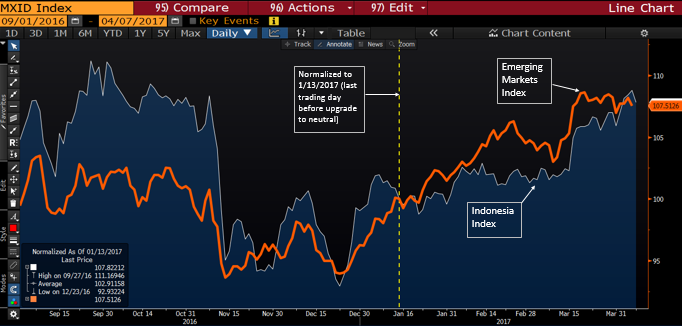
6 months ago, JPMorgan
announced it was downgrading Indonesian equities to “underweight.” That's basically a call to
Sell. Booya! Well, what happened next was that the market showed JPMorgan analysts to have been some sort of geniuses ... but the Indonesian government wasn't quite as enthusiastic.
2 months later, the Indonesian government terminated its business partnerships with JPM, including its status as a primary dealer and a panelist for dollar-bond offerings. Argh. According to
reports, Indonesian Finance Minister Sri Mulyani Indrawati would explain, when asked to comment on the termination of the JPMorgan relationship, that banks should take responsibility for economic reports that "could influence [market] fundamentals and [investment/investor] psychology". Other
reports have an Indonesian official explaining that JPMorgan's downgrade action could destabilize Indonesia’s financial system. In short, "Show People the Optimism" ... or else No More Business for You!
2 weeks later, JPM had
switched Indonesian equities back to
Neutral. This may not have been nefarious. Sure, money speaks, but just look at how "right" the JPMorgan analysts have been! They almost could not have hit the nail any straighter. (Since the original downgrade, Indonesian stocks have underperformed the Emerging Market index by 4.6%; since the reversal to neutral, they have been on par just about perfectly neutral, with the difference being less than 0.1%. Not bad for equity analysts!)
Bigger picture, however, is that we may never know to what degree business interests impacted any specific decisions. But the bullishness of equity analysts, and the known conflicts, certain leave the analysis anything but objective and conflict-free. (One solution is simply to disclose that the analysis is conflicted, rather than to constantly try to pretend it is objective.)
The broken-model of (bank) equity research is being revisited with the ongoing saga that is the Snap IPO, which priced in March at around a $24 billion valuation, only to move up to about $34 billion that day (roughly $25 per share). A
Bloomberg columnist
found that:
- Analysts of 13 banks that were underwriters on Snapchat’s IPO have issued recommendations on the company’s shares. Among those analysts, 69 percent issued "buy" recommendations or the equivalent, with a median price target of $27, according to an analysis of Bloomberg data. (Meanwhile, without drinking the Kool-Aid ....)
- Of the 14 analysts whose firms didn’t work on the Snapchat IPO, only two (14 percent) said the company's stock was worth buying. The median price target among those unaffiliated analysts is $21 a share.
Things became a little more embarrassing when it was
reported that:
- On March 27, Morgan Stanley published an equity research note on Snap, the social media company it helped take public, putting a $28 price target on the stock.
- Almost a day later, the bank issued a correction, changing a range of important metrics in its financial model but not the $28 price target.
Apparently, the bank has found counter-balancing errors that allowed it to maintain the same price despite significant downward adjustments to projections.
One market commentator posed a novel theory that the market knows the price, and so the back-solving or reverse-engineering to obtain the known price doesn't make the research wrong. But it makes us wonder ... if the goal of the research is simply to create some fancy model to justify a price that's pre-conceived, errr, what's the point? And isn't the justification of a pre-conceived valuation misleading to the degree some of the customer-client-prospects thought is was an objective effort to analyze, you know, Snap's real and inherent value? Of course, if it were a contest for American's Next Top Pricing Model, we would be all for producing the Sexiest Equity Pricing Solution ("SEPS").
The answer is known, of course.
The objective of equity research is to make money
elsewhere in the bank, not to be smart and right, but to win (and maintain) banking business. Equity research doesn't, alone, make money: it is given out freely to certain clients and prospects, with the expectation of revenues to be generated elsewhere, like in commissions on trades. But if it's a free product, and its goal is to make money elsewhere, then as soon as it jeopardizes the external prospects, it becomes a burden. And the research analysts know when they're being a burden. So they say
Buy when they need to, and they say,
sure, $28 dollars, the Price is Right, and boy do we have a super-model for you. But independent and conflict-free analysis it is not.
Regulation AC tells us, essentially, that when research analysts tell clients to buy or sell a particular security, they must actually mean what they say. But the product is sweetener. It is quite helpful in selling the coffee. And the coffee can't sell with a salt or pepper alternative.